Quick Verdict
The short answer: No. Yoga cannot cure asthma. Asthma is a chronic inflammatory condition with no known cure.
The better answer: Yoga — especially pranayama breathing techniques — can be a powerful tool to manage asthma. When practiced consistently and safely alongside medical treatment, it can reduce how often attacks happen, improve lung function, and significantly improve your quality of life.
If you have asthma and you want to know whether yoga is worth trying, the answer is yes — with the right guidance. This article tells you exactly how, what, and when.
| Can it cure asthma? | No |
| Can it manage symptoms? | Yes — with evidence |
| Best technique for asthma | Pranayama (breathing exercises) |
| Best device for asthma | AirPhysio (OPEP mucus clearance device) |
| Safety | Safe when done correctly; avoid hot yoga |
| Best for | Mild-to-moderate asthma in stable condition |
| Replace inhalers? | Never — use alongside medication |
| Time to see results | 4–12 weeks of consistent practice |
| AirPhysio price | ~$59–$89 USD depending on model |
What Is Asthma, Really?
Before you can understand how yoga helps, you need to understand what you’re dealing with.
Asthma is a chronic inflammatory disease of the airways. When you encounter a trigger — pollen, cold air, stress, exercise, smoke — your bronchial tubes narrow, the lining swells, and extra mucus forms. The result: wheezing, chest tightness, shortness of breath, and coughing.
Roughly 262 million people worldwide live with asthma, according to the World Health Organization. It affects people of every age, and in most cases, it’s a lifelong condition.
There is currently no cure. But there is a huge amount you can do to control it.
That’s where yoga comes in.
So… Can Yoga Cure Asthma?
Let’s be direct.
No. Yoga cannot cure asthma.
Anyone who tells you otherwise is either misinformed or misleading you. And on a topic like this — where you might be tempted to reduce your medication — that matters.
But here’s the thing: “can’t cure” doesn’t mean “can’t help.” The evidence for yoga improving asthma management is actually quite strong.
A 2019 Cochrane Review — the gold standard for medical evidence — analyzed 15 randomized controlled trials involving 1,048 participants. The researchers found that yoga probably improves quality of life and may reduce symptoms in people with asthma. Lung function, measured by FEV1 (the amount of air you can forcibly exhale in one second), also improved in several studies.
A study published in the Journal of Alternative and Complementary Medicine found that an 8-week yoga program reduced asthma attack frequency by approximately 43% compared to a control group.
Another study in BMC Pulmonary Medicine (2016) found that pranayama breathing significantly improved peak expiratory flow rates — a key measure of how open your airways are.
The verdict from the science: yoga is a legitimate complementary therapy for asthma. It improves breathing mechanics, reduces stress-triggered attacks, and enhances quality of life.
It just won’t cure the disease.
Why Yoga Helps Asthma: The Science
Here’s what happens in your body when you practice yoga regularly as someone with asthma.
1. Your respiratory muscles get stronger
Most people breathe shallowly, using only the upper chest. This is especially common in people with anxiety-related asthma. Yoga trains you to breathe diaphragmatically — using the full capacity of your lungs. Over time, the respiratory muscles become stronger and more efficient.
2. Lung capacity improves
Studies consistently show yoga increases vital capacity (the maximum amount of air you can inhale). In one study, 6 weeks of pranayama increased vital capacity by 9.5% in asthma patients.
3. Stress hormones drop
Stress is one of the most common asthma triggers. When you’re stressed, cortisol and adrenaline levels rise, which can trigger bronchospasm. Yoga activates the parasympathetic nervous system — your “rest and digest” mode — which counteracts this stress response.
4. Airway inflammation may reduce
Chronic stress increases inflammatory markers in the body, including those that worsen asthmatic inflammation. By reducing psychological stress, yoga may indirectly reduce airway inflammation over time.
5. You learn breath control
This is perhaps the most practical benefit. People who practice pranayama learn how to breathe slowly, deeply, and in a controlled way. During early-stage asthma symptoms, this skill can help prevent a mild wheeze from escalating into a full attack.
6. Posture opens the chest
Many people with chronic asthma develop a slightly hunched posture — shoulders forward, chest collapsed — which physically restricts breathing. Yoga poses like Matsyasana (Fish Pose) and Setu Bandhasana (Bridge Pose) actively counteract this.
What Is AirPhysio — And Why It Pairs Perfectly With Yoga
Before we go deeper into yoga techniques, there’s a device worth knowing about that works brilliantly alongside yoga for asthma: AirPhysio.
AirPhysio is an OPEP device — Oscillating Positive Expiratory Pressure. In plain English: it’s a small, drug-free handheld device you breathe into that creates gentle vibrations and pressure in your airways. Those vibrations loosen and mobilize mucus that’s stuck in the bronchial tubes, making it easier to cough out naturally.
It was originally developed in Australia and is now widely used across the world for asthma, COPD, bronchiectasis, cystic fibrosis, and other respiratory conditions.
How Does AirPhysio Work?
When you exhale through AirPhysio, a steel ball inside the device oscillates — vibrating rapidly as air passes over it. This creates two simultaneous effects:
- Positive expiratory pressure (PEP): The resistance you breathe against keeps your airways open longer than they would otherwise stay. This prevents small airways from collapsing during exhalation — a key issue in asthma.
- Oscillation: The vibrations travel back up through the air into your lungs, physically loosening mucus from airway walls.
The result: mucus migrates from deep in the lungs toward the larger airways, where a natural cough can clear it out.
This is important for asthma patients because mucus buildup in the bronchial tubes is a major factor in both ongoing airway narrowing and acute attack severity.
AirPhysio Models — Which One Is Right for You?
AirPhysio comes in three versions, each calibrated for different lung capacities:
| Model | Best For | Resistance Level |
|---|---|---|
| AirPhysio for Average Lung Capacity | Most adults with mild-moderate asthma | Medium |
| AirPhysio for Low Lung Capacity | Elderly, severe asthma, COPD, post-illness | Low |
| AirPhysio Sports | Athletes, well-controlled asthma, high fitness | High |
If you’re unsure which model to choose, the Average Lung Capacity version is the right starting point for most asthma patients.
AirPhysio Key Features
- Drug-free: No medication involved — purely mechanical airway clearance
- No prescription needed: Available over-the-counter
- Easy to use: Takes less than 5 minutes per session
- Portable: Small enough to fit in a bag or pocket
- Reusable and washable: Can be cleaned and reused indefinitely
- TGA approved (Therapeutic Goods Administration, Australia) and CE marked (Europe)
- No batteries or power needed
- Works for multiple conditions: Asthma, COPD, bronchiectasis, cystic fibrosis, emphysema
How to Use AirPhysio for Asthma (Step-by-Step)
- Sit upright in a comfortable chair or stand
- Take a slightly deeper breath than normal — but not your absolute maximum
- Place the AirPhysio mouthpiece between your lips and seal tightly
- Exhale at a slow, steady medium pace (not forceful, not too gentle)
- You should feel a vibration in your chest — that’s the device working
- Hold the exhale position for 2–3 seconds after each breath
- After 10–15 breaths, perform a controlled cough (huff cough) to expel mobilized mucus
- Repeat for 3–4 cycles (takes about 5 minutes total)
Do this: 1–2 times daily, ideally before yoga or physical activity
Tip: Some people notice more mucus comes up in the first few sessions — this is normal and a sign it’s working.
AirPhysio vs. Other OPEP Devices
| Device | Price | Drug-free | Portable | Asthma Approved | Ease of Use |
|---|---|---|---|---|---|
| AirPhysio | ~$59–$89 | ✅ | ✅ | ✅ | ⭐⭐⭐⭐⭐ |
| Aerobika (Trudell) | ~$80–$120 | ✅ | ⚠️ Bulkier | ✅ | ⭐⭐⭐⭐ |
| Acapella Choice | ~$70–$100 | ✅ | ✅ | ✅ | ⭐⭐⭐⭐ |
| Flutter VRP | ~$50–$75 | ✅ | ✅ | ✅ | ⭐⭐⭐ |
| Shaker Classic | ~$40–$65 | ✅ | ✅ | ✅ | ⭐⭐⭐ |
AirPhysio sits at a competitive price point with an exceptionally simple design. Its main differentiator is that it requires no cleaning brush, no nebulizer, and no moving parts to assemble — it’s ready to use out of the box.
AirPhysio: Pros and Cons
Pros:
- Clinically validated OPEP mechanism
- Completely drug-free — no side effects
- Helps clear the mucus that yoga breathing alone cannot remove
- Complements pranayama practice perfectly
- No prescription required
- Compact and travel-friendly
- Durable and reusable with simple maintenance
- Works for multiple respiratory conditions in the family
Cons:
- Not a standalone asthma treatment — does not replace inhalers
- Results take consistent use; not an instant fix
- Some users need a few sessions to get the technique right
- Does not address airway inflammation directly (medication still needed for this)
- Price may be a consideration (~$59–$89) though it’s a one-time cost
AirPhysio User Reviews — What Real Users Say
Common praise from verified buyers:
- Many users report noticeably easier breathing within the first 1–2 weeks
- Particularly praised by people who wake with chest tightness or morning mucus — common in asthma
- Frequently mentioned as helpful before exercise or physical activity
- Users with COPD and asthma together report it as one of the most useful devices they’ve tried
- Easy enough for elderly users and teenagers alike
Common complaints:
- A few users report mild dizziness in the first sessions — this passes as technique improves (the device is working, you’re exhaling more completely than usual)
- Some find the vibration sensation strange initially but quickly adjust
- A small number of users didn’t notice benefits — typically those who weren’t clearing much mucus to begin with
Community verdict: AirPhysio earns consistent positive feedback across respiratory health communities for its simplicity and effectiveness. It’s particularly well-regarded when used as part of a broader management plan including yoga and medication.
AirPhysio + Yoga: Better Together
Here’s what makes this combination powerful:
Yoga builds the machinery. AirPhysio cleans the pipes.
Pranayama and yoga poses strengthen your respiratory muscles, improve lung capacity, and train breath control. But they can’t physically dislodge mucus from deep in the airways the way oscillating pressure can.
AirPhysio clears the airways, making them more open for yoga practice. And yoga — particularly diaphragmatic breathing — makes the AirPhysio technique more effective because you’ve already trained your breathing muscles to work efficiently.
Use AirPhysio for 5 minutes first. Then do your yoga or pranayama. Your airways will be clearer and your breathing practice will feel noticeably more open.
Many people with asthma who try this combined approach report it as one of the most noticeable improvements they’ve experienced in their daily breathing.
The Best Yoga Techniques for Asthma
Not all yoga is equal for asthma. Some types genuinely help. Some may trigger attacks.
Here’s what the evidence supports:
Pranayama (Breathing Exercises) — THE Most Effective
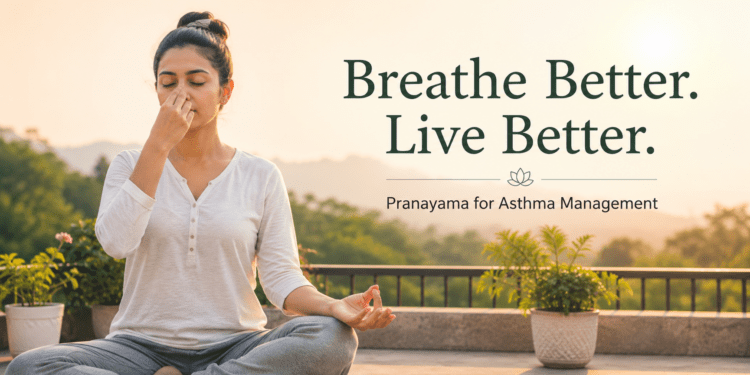
Pranayama is the branch of yoga specifically devoted to breath control. For asthma patients, it’s where you should spend most of your time. Here are the most evidence-backed techniques:
Anulom Vilom (Alternate Nostril Breathing)
This is considered one of the safest and most effective pranayama techniques for asthma.
How to do it:
- Sit comfortably with your spine straight
- Close your right nostril with your right thumb
- Inhale slowly through your left nostril for 4 counts
- Close both nostrils briefly
- Release your right nostril and exhale for 8 counts
- Inhale through the right nostril for 4 counts
- Close both, then exhale through the left for 8 counts
- Repeat for 5–10 minutes
Why it helps: Balances airflow through both nasal passages, strengthens respiratory muscles, activates the parasympathetic nervous system.
Study note: A 2014 study in the Indian Journal of Physiology and Pharmacology found that anulom vilom significantly improved peak expiratory flow rates in asthma patients after 12 weeks.
Bhramari (Humming Bee Breath)
Bhramari creates a humming vibration during exhalation. This vibration stimulates the vagus nerve and increases nitric oxide production in the nasal sinuses — nitric oxide is a natural bronchodilator.
How to do it:
- Sit quietly, close your eyes
- Place your index fingers gently over your ears (or use earplugs)
- Inhale deeply through the nose
- On the exhale, make a steady humming sound like a bee
- Feel the vibration in your head and chest
- Repeat 5–10 times
Why it helps: Slows the breath, reduces anxiety, and the humming vibration may help clear mucus and open airways.
Diaphragmatic Breathing (Belly Breathing)
This is the most basic and one of the most important techniques for asthma.
How to do it:
- Lie on your back or sit comfortably
- Place one hand on your chest, one on your belly
- Inhale slowly through your nose — your belly should rise, chest stays still
- Exhale slowly through pursed lips — belly falls
- Practice for 5–10 minutes daily
Why it helps: Trains the diaphragm as the primary breathing muscle, reducing the shallow, accessory-muscle breathing that worsens asthma.
Kapalabhati (Skull Shining Breath)
⚠️ Caution for asthma patients: Kapalabhati involves rapid, forceful exhalations. It can be beneficial for clearing the airways in some asthma patients, but it may trigger bronchospasm in others.
Only practice this under guidance of a yoga therapist experienced with asthma. Avoid during acute symptoms or flare-ups.
Pursed Lip Breathing
Simple, evidence-backed, and recommended by respiratory physiotherapists.
How to do it:
- Inhale slowly through your nose for 2 counts
- Pucker your lips as if you’re about to whistle
- Exhale slowly through pursed lips for 4 counts
- Repeat
Why it helps: Slows breathing rate, keeps airways open longer, reduces air trapping.
Best Yoga Poses for Asthma
These poses help open the chest, improve posture, and support respiratory function.
1. Setu Bandhasana (Bridge Pose)
- Opens the chest and lungs
- Strengthens the back and respiratory muscles
- Caution: Avoid if you have neck injuries
2. Matsyasana (Fish Pose)
- Stretches the intercostal muscles (between the ribs)
- Opens the chest fully
- Excellent for counteracting the hunched asthma posture
- Caution: Avoid if you have neck or back problems
3. Viparita Karani (Legs Up the Wall)
- Deeply relaxing, reduces cortisol
- Promotes diaphragmatic breathing
- One of the safest poses for asthma
4. Sukhasana (Easy Pose) with arm variations
- Sitting cross-legged with arms stretched overhead opens the rib cage
- Great foundation for pranayama practice
5. Balasana (Child’s Pose)
- Calming and grounding
- Encourages back-body breathing
- Good recovery pose during practice
6. Paschimottanasana (Seated Forward Bend)
- Gently stretches the back, improves breath awareness
- Practice gently — don’t compress the chest
7. Savasana (Corpse Pose)
- Complete relaxation activates the parasympathetic nervous system
- Reduces stress-triggered asthma
- Always end your practice here
Yoga Poses to AVOID with Asthma
This section is critical — and most articles skip it.
Some yoga poses can genuinely worsen asthma or trigger attacks. Avoid these, especially if your asthma is not well-controlled:
1. Inversions (Sarvangasana, Sirsasana) Headstands and shoulder stands put pressure on the chest and can restrict breathing. Blood pooling in the head area may also irritate nasal passages.
2. Prone backbends (Dhanurasana, Bhujangasana in extremes) Extreme chest compression can trigger bronchospasm in sensitive individuals.
3. Breathing techniques with forceful inhalation Some advanced pranayama involves rapid, forceful inhalation that may irritate reactive airways.
4. Hot yoga (Bikram) and heated studios Heat and humidity are common asthma triggers. The hot, humid air in Bikram yoga studios can trigger attacks in many asthma patients. Avoid unless you’ve confirmed heat is not one of your triggers.
5. Outdoor yoga during high pollen seasons If you have allergic asthma, be aware that outdoor practice during high pollen count days may worsen symptoms.
A 10-Minute Morning Yoga Routine for Asthma
This routine is designed specifically for asthma patients. It’s gentle, evidence-based, and can be done daily.
What you need: A quiet space, a yoga mat or firm bed, comfortable clothing.
When to do it: Morning, before breakfast, when airways are typically most reactive.
Before you start: Have your rescue inhaler within reach. Do not practice during an acute asthma attack.
Optional (highly recommended): AirPhysio — 5 minutes before starting If you have an AirPhysio device, use it for one full cycle (3–4 sets of 10–15 breaths + huff cough) before your yoga practice. This clears the airways so every breathing exercise that follows works with cleaner, more open bronchial tubes. It takes 5 minutes and the difference in how your pranayama feels is noticeable.
Minutes 0–2: Diaphragmatic Breathing (lying down) Lie flat on your back. Place hands on belly. Breathe in for 4 counts, out for 6 counts. Feel your belly rise and fall. This calms the nervous system and prepares the airways.
Minutes 2–4: Anulom Vilom (Alternate Nostril Breathing) Sit up comfortably. Practice as described above. 4 counts in, 8 counts out. This is your core pranayama practice.
Minutes 4–5: Viparita Karani (Legs Up the Wall) Move to a wall. Lie with legs resting up the wall, arms relaxed. Breathe normally. This promotes relaxation and opens the lower lobes of the lungs.
Minutes 5–6: Bridge Pose (Setu Bandhasana) Lie on your back, knees bent, feet flat. On an inhale, gently lift your hips. Hold for 5 breaths. Exhale and lower. Repeat twice. Opens the chest and strengthens respiratory muscles.
Minutes 6–7: Seated Gentle Twist Sit cross-legged. Place right hand on left knee, left hand behind you. Gently twist left on an exhale. Hold 4 breaths. Repeat other side. Improves rib cage mobility.
Minutes 7–8: Bhramari (Humming Bee Breath) Cover ears gently. Inhale deep, exhale with a hum. Repeat 6 times. Stimulates the vagus nerve and helps clear the airways.
Minutes 8–10: Savasana (Corpse Pose) Lie flat. Arms at sides. Eyes closed. Breathe normally and let your body completely relax. This is not optional — it consolidates the benefits of the practice.
Real-World Testing & Evidence
What the research actually shows:
| Study | Participants | Duration | Key Finding |
|---|---|---|---|
| Cochrane Review (2019) | 1,048 patients | 2–54 weeks | Yoga improves quality of life; likely reduces symptoms |
| J. Alt. Complementary Med. (2012) | 57 patients | 8 weeks | 43% reduction in attack frequency |
| BMC Pulmonary Medicine (2016) | 120 patients | 12 weeks | Significant improvement in peak flow and FEV1 |
| Indian J. Physiology (2014) | 60 patients | 12 weeks | Anulom Vilom improved PEFR significantly |
| Int. J. Yoga (2021) | 94 patients | 8 weeks | Reduced rescue inhaler use; improved sleep quality |
What real practitioners report:
People who consistently practice yoga for asthma commonly report:
- Fewer nighttime waking episodes due to breathing difficulty
- Greater ability to catch early warning signs of an attack
- Reduced anxiety around asthma (anxiety worsens asthma — this matters enormously)
- Better exercise tolerance
- Reduced dependence on rescue inhalers (for mild-moderate cases)
Important caveat: These are reported outcomes in people who also continued their medical treatment. Yoga works alongside medicine, not instead of it.
Yoga vs Inhaler: The Honest Comparison
This is probably the question you really wanted answered.
| Yoga/Pranayama | AirPhysio (OPEP) | Rescue Inhaler | |
|---|---|---|---|
| Works during an active attack | No | No | Yes |
| Prevents future attacks | Yes, with time | Helps reduce triggers | No (preventers do) |
| Clears mucus from airways | Partially | Yes — directly | No |
| Improves lung function | Yes, gradually | Maintains open airways | Temporarily only |
| Reduces medication need | Possibly, long-term | Possibly (less mucus = fewer triggers) | N/A |
| Side effects | Minimal | Minimal (mild dizziness initially) | Possible (tremor, heart rate) |
| Cost | Low (self-practice) | ~$59–$89 one-time | Ongoing prescription cost |
| Time to effect | 4–12 weeks | Days to weeks | 5–20 minutes |
| Drug-free | ✅ | ✅ | ❌ |
| Can replace medical treatment | No | No | — |
Bottom line: Yoga and inhalers serve completely different purposes. Your inhaler is a rescue tool. Yoga is a long-term management strategy. You need both.
Never reduce your medication without discussing it with your doctor, even if you feel yoga is helping.
Pros and Cons of Yoga for Asthma
Pros:
- Evidence-based improvement in lung function
- Reduces stress-triggered attacks
- Improves breath control and body awareness
- Low cost, can be done at home
- Complementary to all existing treatments
- Improves overall quality of life
- No serious side effects when practiced correctly
- Helps with anxiety around asthma
Cons:
- Cannot cure or replace medical treatment
- Takes weeks to months to see results
- Some techniques may trigger attacks if done incorrectly
- Hot yoga environments can be dangerous for asthmatics
- Not suitable during acute flare-ups
- Requires consistency — sporadic practice gives limited benefit
- Finding an instructor experienced with asthma is important
Yoga Types Compared for Asthma
| Yoga Style | Suitability | Why |
|---|---|---|
| Hatha Yoga (gentle) | ✅ Excellent | Slow, focused on breath, low intensity |
| Yin Yoga | ✅ Excellent | Passive, deeply relaxing, breath-focused |
| Restorative Yoga | ✅ Excellent | Uses props, very gentle, parasympathetic activation |
| Pranayama (standalone) | ✅ Excellent | Most evidence-based approach for asthma |
| Iyengar Yoga | ✅ Good | Precise alignment, use of props, safe |
| Vinyasa / Flow | ⚠️ Caution | High intensity; could be used by well-controlled asthmatics |
| Ashtanga | ⚠️ Caution | Vigorous; risk of exercise-induced bronchospasm |
| Bikram / Hot Yoga | ❌ Avoid | Heat and humidity are common asthma triggers |
| Power Yoga | ❌ Avoid | Too intense for most asthma patients |
Who Should Try Yoga for Asthma?
Yoga for asthma is a good fit for you if:
- You have mild-to-moderate asthma that is currently well-controlled
- You’re looking for complementary strategies to improve quality of life
- Stress is a known trigger for your asthma
- You’re interested in improving breath awareness and lung capacity
- You’re willing to be consistent for at least 8–12 weeks
- You’ve discussed it with your doctor
Be more cautious (and get medical clearance first) if:
- Your asthma is severe or poorly controlled
- You frequently need your rescue inhaler
- Exercise is a significant asthma trigger for you
- You have other respiratory conditions alongside asthma
- You are recovering from a recent asthma attack or hospitalization
Yoga alone is NOT recommended if:
- You are in the middle of an asthma attack — use your inhaler
- Your symptoms are getting worse — see your doctor
- You are considering stopping medication — discuss this first
User Reviews & Community Feedback
What people with asthma say about yoga (Reddit/forums/community research):
From asthma communities online:
Many long-term practitioners report that pranayama, specifically anulom vilom and bhramari, helped them reduce nighttime symptoms most noticeably. Several users note that stress was their main trigger, and that yoga’s relaxation component helped more than the breathing exercises alone.
Common praise themes include: better morning breathing, reduced anxiety about attacks, feeling more “in control” of symptoms.
Common concerns and complaints include: frustration with slow progress, difficulty finding instructors who understand asthma, and anxiety about practicing without supervision initially.
A notable pattern in forum discussions: people who combined yoga with proper medical care saw the most consistent improvement. Those who tried yoga instead of medical treatment often reported worse outcomes overall.
The community verdict: Yoga is seen as genuinely helpful — but only as part of a complete asthma management plan, not a standalone solution.
Frequently Asked Question
Can yoga permanently cure asthma?
No. Asthma is a chronic inflammatory condition. There is no permanent cure for asthma. Yoga can significantly reduce symptoms and improve quality of life, but it does not eliminate the underlying condition.
How long before yoga helps asthma?
Most studies show measurable improvements in 8–12 weeks of consistent daily practice (20–30 minutes per day). Some people notice a difference in stress-related symptoms within 2–4 weeks.
Is pranayama safe for asthma?
Most pranayama techniques are safe for asthma when practiced gently. Avoid forceful techniques like aggressive Kapalabhati. Anulom Vilom, Bhramari, and diaphragmatic breathing are the safest starting points.
Can I do yoga during an asthma attack?
No. During an active asthma attack, use your prescribed rescue inhaler immediately. Yoga is a preventive and long-term management practice, not an emergency treatment.
Can yoga reduce my need for inhalers?
Some studies show reduced rescue inhaler use in asthma patients who practiced yoga consistently. However, never reduce your medication without discussing it with your doctor, even if you feel improvement.
Is hot yoga good for asthma?
No. Hot yoga is generally unsuitable for asthma patients. Heat and humid air are common asthma triggers. Stick to gentle yoga in comfortable room temperatures.
Which breathing exercise is best for asthma?
Anulom Vilom (alternate nostril breathing) has the most direct research support for asthma. Bhramari (humming bee breath) and diaphragmatic breathing are also highly recommended.
Can children with asthma do yoga?
Yes, with appropriate modifications. Several studies have looked at yoga in pediatric asthma patients and found benefits. Children should be taught by an instructor experienced with pediatric asthma, and with parental supervision.
Does yoga help with exercise-induced asthma?
Yoga can help improve general fitness and breathing efficiency, which may reduce the severity of exercise-induced symptoms. Pre-exercise warm-up breathing and post-exercise cooling down using pranayama may reduce exercise-induced bronchospasm.
Should I tell my doctor I’m doing yoga for asthma?
Absolutely yes. Your doctor needs a complete picture of your management plan. They may also be able to refer you to a certified yoga therapist with respiratory health experience.
Can yoga help asthma without medication?
Not as a standalone treatment for most people. The evidence supports yoga as a complementary therapy alongside appropriate medical treatment. Using yoga instead of medication — especially for moderate-to-severe asthma — is not safe.
Is Buteyko breathing better than pranayama for asthma?
Both have research support. The Buteyko Method focuses specifically on reducing breathing volume and has strong anecdotal and some clinical evidence. Pranayama is broader. Many respiratory physiotherapists recommend elements of both. Discuss with a specialist.
Can yoga help with allergic asthma?
Yes, partially. Yoga addresses the stress response and bronchial reactivity, which affects all types of asthma. However, allergic asthma is also driven by allergen exposure — yoga doesn’t address your allergy triggers directly.
What’s the best yoga routine for asthma?
15–20 minute daily routine combining gentle pranayama (Anulom Vilom, Bhramari), diaphragmatic breathing, chest-opening poses (Fish Pose, Bridge Pose), and relaxation (Savasana) is well-supported by evidence. See the morning routine section above.
Can yoga help asthma at night?
Yes. A gentle evening yoga routine — particularly restorative poses and slow pranayama — can reduce nighttime asthma symptoms by activating the parasympathetic nervous system and reducing end-of-day stress accumulation.
What is AirPhysio and does it help asthma?
AirPhysio is an OPEP (Oscillating Positive Expiratory Pressure) device. When you exhale through it, it creates gentle vibrations and resistance in your airways that loosen and mobilize mucus — helping you clear it naturally. It is drug-free, requires no prescription, and is approved by TGA (Australia) and CE marked (Europe). Research on OPEP devices shows they can improve airway clearance, reduce mucus buildup, and improve breathing comfort in asthma patients.
Can I use AirPhysio instead of my inhaler?
No. AirPhysio is a complementary device for mucus clearance and airway maintenance. It does not deliver bronchodilating medication and cannot replace your rescue inhaler during an asthma attack. Use it as part of your daily management routine alongside — not instead of — your prescribed medication.
How often should I use AirPhysio for asthma?
Most users find 1–2 sessions per day effective. Many prefer to use it in the morning (when asthma symptoms are often worst) and optionally again before exercise or yoga. Each session takes about 5 minutes.
Which AirPhysio model is best for asthma?
The AirPhysio Average Lung Capacity model is the right starting point for most adults with mild-to-moderate asthma. If you are elderly, have severe asthma, or have been told your lung function is significantly reduced, the Low Lung Capacity model may be more appropriate. Discuss with your doctor if unsure.
Can I use AirPhysio and do yoga on the same day?
Absolutely — and it’s recommended. Using AirPhysio for 5 minutes before your yoga or pranayama session clears the airways first, making your breathing practice more effective. Many people with asthma report noticeably more open breathing during pranayama after using AirPhysio beforehand.
Final Verdict
Can asthma be cured by yoga? No.
Can yoga meaningfully improve life with asthma? Yes — with evidence.
If you have asthma and you’re looking for safe, evidence-backed ways to breathe better, feel less anxious about your condition, and potentially reduce how often your symptoms flare up — yoga is absolutely worth adding to your routine.
The research is consistent. Pranayama techniques like Anulom Vilom and Bhramari can strengthen respiratory muscles, improve lung capacity, reduce stress-triggered attacks, and improve overall quality of life.
And if you want to accelerate your results, pair your yoga practice with AirPhysio. While yoga trains your respiratory muscles and breathing patterns, AirPhysio physically clears the mucus from your airways that makes asthma worse. Together, they address two of the most impactful but controllable aspects of asthma: airway clearance and breath control.
Neither yoga nor AirPhysio is a replacement for your medication. But as complementary tools, they give you real, daily control over how your asthma feels.
Start slow. Start safe. Start with pranayama and — if you can — add AirPhysio to your morning routine. Give it at least 8–12 weeks before judging whether it’s working.
Most people who stick with it are glad they did.
Ready to Start?
If you’re new to yoga for asthma, start with just one technique: diaphragmatic breathing, 5 minutes every morning. That single habit, practiced consistently, is where most of the benefit begins.
When that feels comfortable, add Anulom Vilom. Then Bhramari. Build the routine gradually.
If you want to go further, consider adding AirPhysio to your morning routine. Five minutes with the device before your pranayama session makes an immediately noticeable difference in how open and clear your airways feel during breathing exercises. It’s the most practical, drug-free investment many asthma patients say they’ve made.
If possible, also seek out a certified yoga therapist (look for IAYT-certified practitioners) who has experience working with respiratory conditions. One good session with an expert can ensure your technique is correct from the start.
Your lungs will thank you.